
The Personal TV Channel™ of Amy Lynn Freeman
Virtual Harmonics, LLC at virtualharmonics.com

Enterprise Architecture transformed institutions. Virtual Harmonics, LLC extends that architecture to individuals.
Virtual Harmonics, LLC is a technology-enabled independent media and symbolic infrastructure company based in Sacramento, California.
Virtual Harmonics, LLC builds, deploys, and orchestrates User-Composed Applications within an independent dynamically distributed AI Business-Technology Infrastructure and Enterprise Architecture Model built for individuals: Enterprise Architecture for Individuals(TM).
Our Individuality and Recognition Management(TM) framework, IRM(TM), translates the organizing purpose of Customer Relationship Management into a system controlled by the individual.
Through a portfolio of media brands, proprietary operating methods, and protected intellectual property, the company develops Object-Oriented Media™, compositional AI-era workflows, and user-defined orchestration systems for transforming structured information across identities, organizations, and interactive environments.
Enterprise Architecture created the modern institution.
AI is creating a need for Individual Architecture.
Existing institutions maintain partial representations of individuals.
No widely adopted architectural framework places the individual in control of an equivalent authoritative layer spanning identity, recognition, communications, commerce, and compositional workflows.
This creates friction across identity, finance, commerce, communications, AI, and knowledge exchange.
We have been developing a reference architecture for that missing layer since the late 1990s.
In the Virtual Harmonics™ architecture, applications are no longer treated as the enduring system. They become one possible runtime for an enduring authoritative object. The object—not the application—defines identity, governance, relationships, policy, provenance, and execution across changing technologies.
What is Virtual Harmonics™?
In acoustics and psychoacoustics, virtual harmonics describe the phenomenon of the missing fundamental or virtual pitch—where the human brain perceives a complete tone even when the foundational note itself is absent. Although the fundamental frequency cannot be directly heard, its presence is inferred from the relationships among the remaining harmonics, allowing listeners to perceive a coherent whole.
Virtual Harmonics™ applies this principle to human, organizational, and economic systems.
The Missing Fundamental as an Architectural Principle
The phenomenon of the missing fundamental is not unique to acoustics.
It is a more general property of complex systems.
When relationships among observable components are sufficiently coherent, humans naturally infer the presence of an underlying organizing structure—even when that structure is not directly represented.
Virtual Harmonics™ proposes that many modern information systems exhibit the same characteristic.
Rather than failing because individual technologies are inherently flawed, many systems become fragmented because their underlying object model is incomplete. They contain representations of transactions, applications, identities, permissions, and communications, yet lack a sufficiently coherent representation of the enduring object that those systems are intended to serve.
As a result, organizations continuously compensate for missing architectural assumptions through increasingly complex software, duplicated information, manual reconciliation, and growing layers of governance.
The problem is not simply one of information security, artificial intelligence, or software engineering.
It is an architectural problem.
Then I would introduce Object-Oriented Objects™.
Not as a product.
As the proposed missing architectural layer.
Object-Oriented Objects™
Object-Oriented Objects™ introduces a compositional object model intended to serve as a stable architectural foundation across multiple domains.
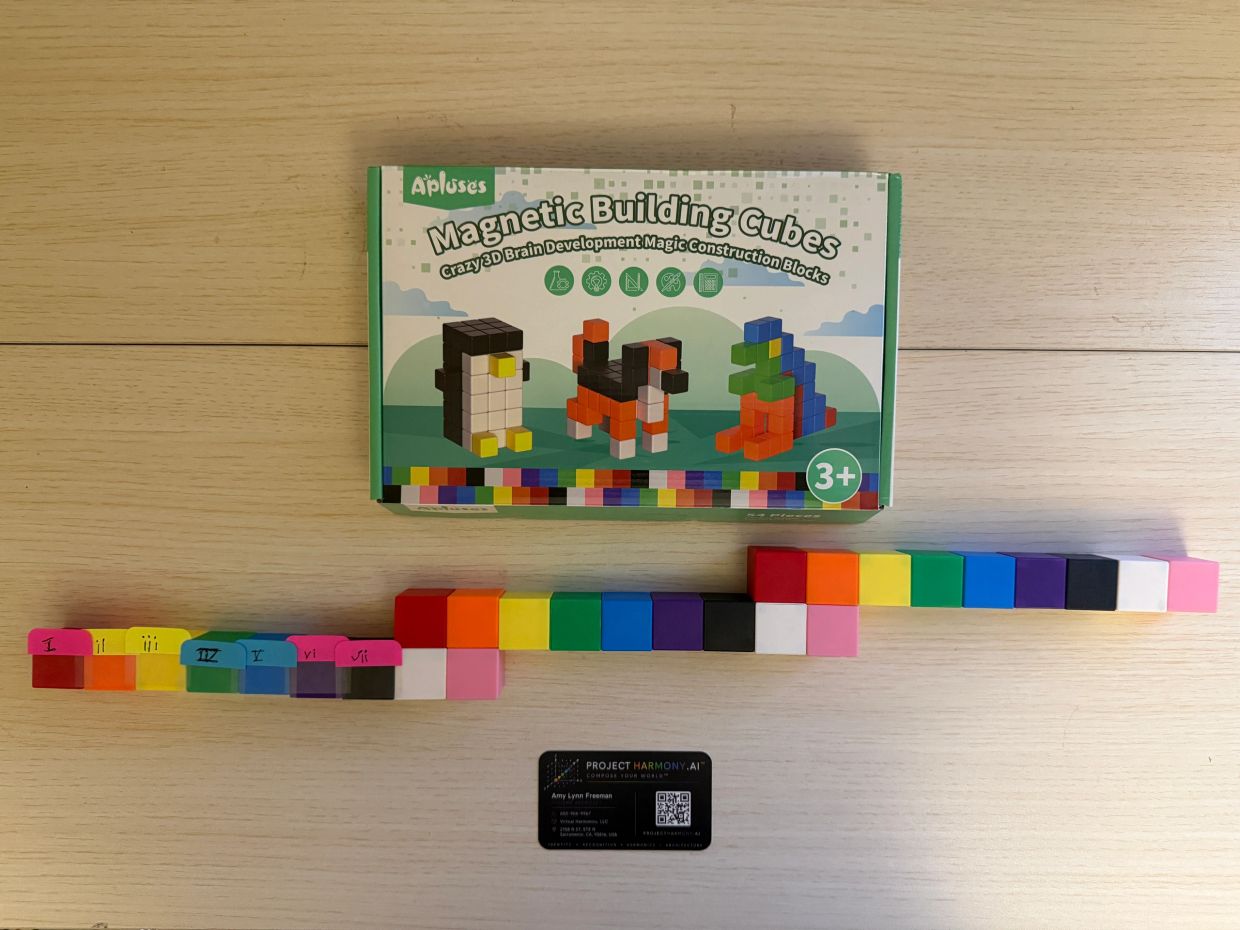
Rather than beginning with applications, databases, or institutions, the model begins with a small, finite set of reusable symbolic objects.
The foundational object is represented as a seven-tone diatonic scale.
This scale serves as the baseline vocabulary for conceptual composition throughout the Virtual Harmonics™ ecosystem.
Like musical harmony, these objects may be transposed, incremented, combined, layered, and recursively composed without changing their underlying relationships.
The framework therefore scales through composition rather than proliferation.
Simple objects become more sophisticated structures while preserving semantic continuity across increasingly complex systems.
This same compositional vocabulary is used consistently throughout Virtual Harmonics™, Color Harmonics™, Symphone Networks™, SaaSi Cubes™, Object-Oriented Media™, and related operating methods.
Over the past thirty years, Enterprise Architecture transformed the modern institution by creating formal architectures for business processes, applications, information, data, technology, governance, communications, and commerce. Yet the most important participant in those systems—the individual—has never been granted an equivalent architectural layer. Individuals exist within institutional systems, but are typically represented only through fragmented records maintained by organizations, platforms, and service providers.
Virtual Harmonics™ proposes that the individual is the missing fundamental of the modern information economy.
By introducing a corresponding architecture for identity, language, connection, recognition, exchange, distribution, and performance, Virtual Harmonics™ enables individuals and organizations to participate within a more complete and coherent digital environment. Just as the missing fundamental allows listeners to perceive a complete musical structure, Virtual Harmonics™ seeks to restore the missing human voice within modern information, economic, and AI systems.
From an enterprise architecture perspective, this corresponds to re-centering the architecture around the authoritative object rather than the consuming application.
The SaaSi Cubes™ Virtual Application Container™ does not merely generate applications. It encapsulates the object definitions, governance policies, references, security, relationships, execution state, and deployment instructions required to instantiate a runtime appropriate to the current environment.
Applications become one possible runtime.
The container is the enduring asset.
It carries:
- object definitions,
- policies,
- references,
- security,
- relationships,
- state,
- deployment instructions.
The application becomes one possible runtime.
The container is the enduring asset.

Object-oriented media™

Object-oriented media™
Perpendicular Systems™
Our Approach
Perpendicular Systems™ at PerpendicularSystems.com
Our Technology Division, Perpendicular Systems, develops Virtual Distributed Symbolic SaaSish User-Composed Components called "SaaSi Cubes"™ designed for artists, musicians, individuals and small businesses.
Our Virtual Harmonics "Deliberately Disaggregated Architecture Model"™, or DDAM, allows for the integration and processing of both real and imaginary associations between data on different planes of operation and in different systems.
About Virtual Harmonics, LLC
Tiny Tech Entrepreneurs™
From Poster:
Built referencing my previous work building the Enterprise Architectures of large companies, my current approach is called:
"Enterprise Architecture for Individuals", or EAI.
EAI provides a structured method for transforming complex processes into simple, composable systems.
=========================================
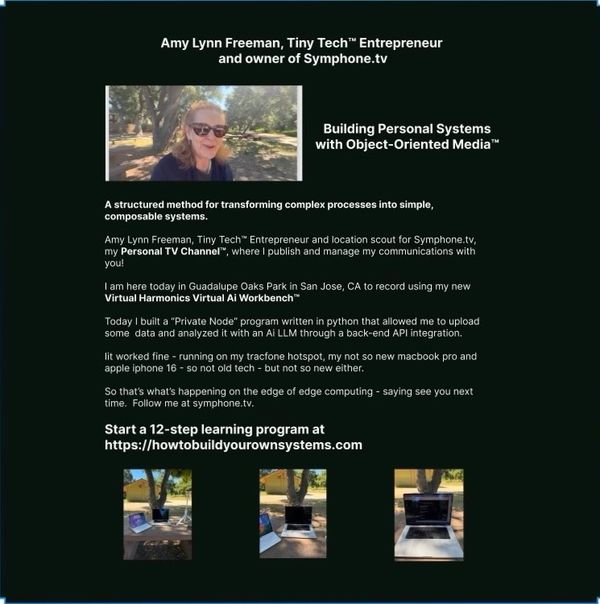
Amy Lynn Freeman, Tiny Tech™ Entrepreneur and location scout for Symphone.tv, my Personal TV Channel", where I publish and manage my communications with you!
"I am here today in Guadalupe Oaks Park in San Jose, CA to record using my new Virtual Harmonics Virtual Ai Workbench™
Today I built a "Private Node" program written in python that allowed me to upload some data and analyze it with an Ai LLM through a back-end API integration.
It worked fine - running on my tracfone hotspot, my not so new macbook pro and apple iphone 16 - so not old tech - but not so new either.
So that's what's happening on the edge of edge computing - saying see you next time. Follow me at symphone.tv as I explore the world of sometimes-connected media in the edge-computing environment."
What to join me?
Start a 12-step learning program at https://symphone.tv/shopharmonics-com/ols/products/howtobuildyourownsystems-com
“Live Experimental Runtime Prototypes”
And link:
- Private Processing Node - https://huggingface.co/spaces/virtualharmonics/private-processing-node
- VHIFHI Interaction Analyzer - https://huggingface.co/spaces/virtualharmonics/vhifhi-interaction-analyzer
- Cube Analysis Workbench - https://huggingface.co/spaces/virtualharmonics/mobileworkspace
About Symphone.tv™ Personal TV Channel™
Virtual Piano Studio™
Virtual Piano Studio™ is my private network of music education, production and performance projects, including:
https://belcantoproductions.com

Mountain View Piano™
Mountain View Piano™ is a private music studio offering piano and guitar lessons for children, teens, and adults. Lessons focus on creativity, musicianship, and performance skills using the Simply Music, Justin Guitar and other contemporary learning methods.
Color Harmonics™
Color Harmonics™ is a method of establishing imaginary, theoretical and abstract relationships between music, art and symbols.

Shop Harmonics™
Shop Harmonics™ is a proprietary method of creating a Personal Virtual Commerce Management System™.

Bel Canto Productions™
Bel Canto Productions™ is a service of Perpendicular Systems, the Technology Division of Virtual Harmonics, LLC, providing composable business technology architecture, design and consulting services for distributed music production, performance and distribution.
Perpendicular Systems™
A system for organizing complex problems into clear, working structures
Most systems don’t fail because they are too complex.
They fail because they are framed incorrectly.
When technical, business, and operational perspectives don’t align, systems become fragmented and difficult to use.
Perpendicular Systems™ addresses this by reframing problems across domains so the system can function as a whole.