
The Personal TV Channel™ of Amy Lynn Freeman
Object Oriented Music™ and objectorientedmusic.com

OBJECT ORIENTED MUSIC™
Object-Oriented Music™ is a method for representing musical structure as reusable symbolic objects rather than fixed notation.
Instead of treating music only as notes on a staff, OOM models relationships such as interval, rhythm, repetition, variation, and phrase structure as manipulable spatial objects.
This allows musical performance, composition, memory, and analysis to be explored across visual, physical, computational, and embodied forms.
Object-Oriented Music™
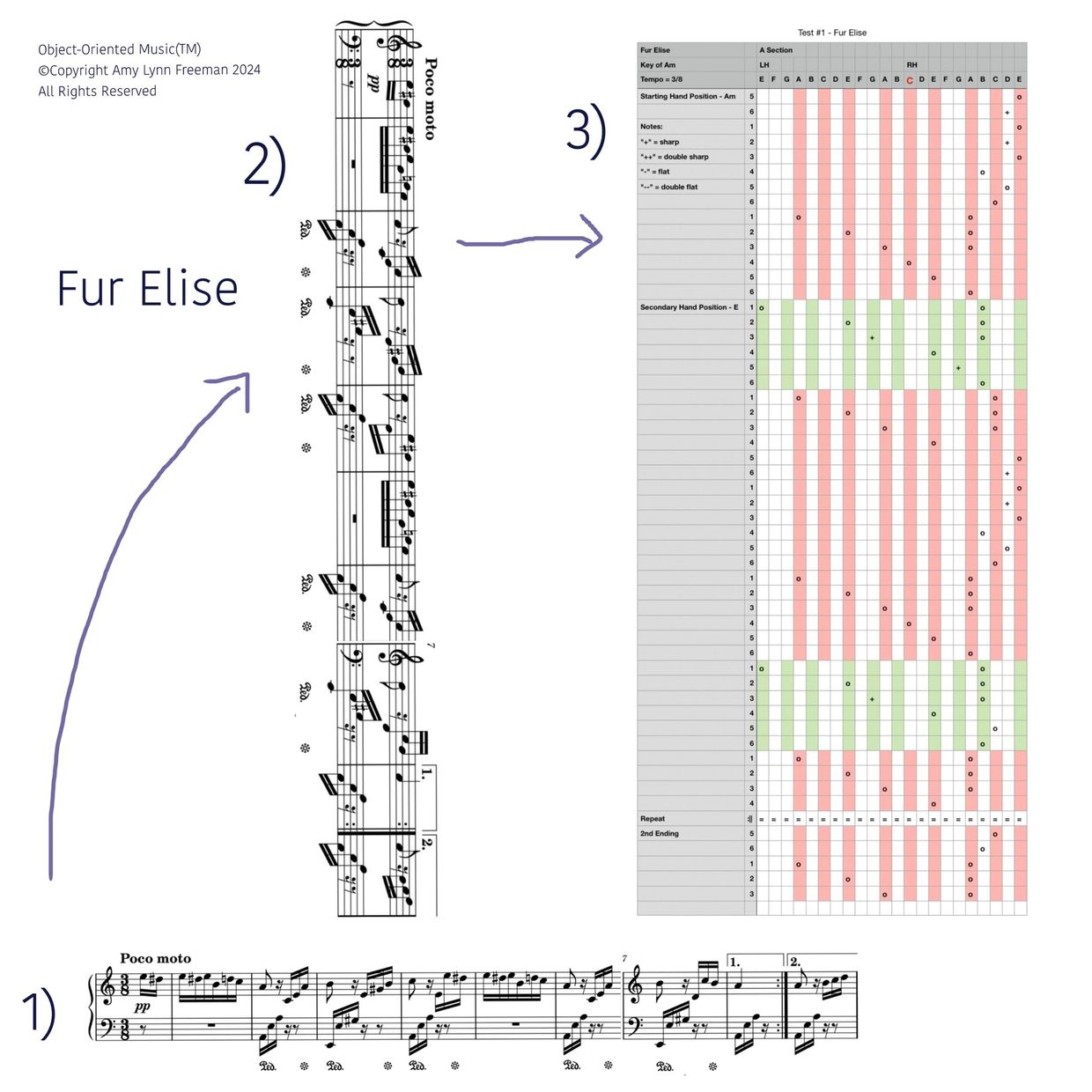
Our Mission
Object-Oriented Music™
PATTERN • SYMBOL • PERFORMANCE
Object-Oriented Music™ (“OOM”) is a generative symbolic framework for representing musical structure as reusable spatial objects rather than fixed notation alone.
Instead of treating music only as notes on a page, OOM models relationships such as rhythm, interval, repetition, variation, phrase structure, fingering, timing, and performance movement as manipulable symbolic objects that can be translated across visual, spatial, computational, and embodied forms.
Object-Oriented Music™ focuses on the sequence of actions the performer’s body must execute over time. Musical performance is therefore explored not only as abstract notation, but as an integrated structure of movement, memory, coordination, timing, repetition, and spatial pattern recognition.
The system developed through over fifteen years of teaching, performance, systems research, and experimentation in music pedagogy, visual abstraction, symbolic systems design, and computational modeling.
Music is used as the foundational domain because it is one of the earliest symbolic systems most people learn intuitively. Long before formal training, people understand repetition, variation, rhythm, tension, release, harmony, and form through listening and physical interaction. Object-Oriented Music™ uses this shared symbolic literacy as a basis for exploring broader systems of cognition, composition, symbolic representation, and human-centered system design.
At the center of the framework is a diatonic sequence structure derived from instructional work shared with Amy Lynn Freeman by musician Glenn “Houston” Pomianek and later expanded into a broader generative teaching model for students at Mountain View Piano™. These harmonic relationships were later abstracted into coordinate systems, visual grids, color structures, modular symbolic objects, and computational representations.
The framework draws from studies in Philosophy of Science at SUNY, Artificial Intelligence and Machine Learning training through Caltech, generative music education through the Simply Music™ piano method, developmental cognition, visual abstraction through Kandinsky and Klee, and color relationship studies inspired in part by Leonardo da Vinci.
Painting Music™ applies Object-Oriented Music™ to visual musical representation and embodied performance learning. Color Harmonics™ extends the same object relationships into visual abstraction and symbolic color systems. SaaSi Cubes™ expand the framework into modular symbolic environments for computational thinking, organizational systems, and information architecture.
The diagrams, sketches, charts, software experiments, visual systems, and teaching artifacts presented throughout this project document the evolution of Object-Oriented Music™ through experimentation, composition, teaching, and applied systems research over time.
Object-Oriented Music™ approaches musical learning as a generative process involving perception, memory, symbolic compression, movement, experimentation, visual structure, and embodied performance.
Historical views on "universal correspondence" between color
Color and Music
Object-Oriented Music™ is related to — but distinct from — historical attempts to establish fixed or “universal” correspondences between music and color.
Research conducted as part of the development of Color Harmonics™, Painting Music™, and related systems examined a wide range of historical theories connecting music, color, visual abstraction, and symbolic structure, including the work of Isaac Newton, Louis Bertrand Castel, Wassily Kandinsky, Johannes Itten, Alexander Scriabin, Paul Klee, and other artists, theorists, and composers who explored parallels between visual and musical organization.
While many of these systems proposed direct note-to-color mappings or synesthetic correspondences, the research underlying Object-Oriented Music™ suggests that no single universal translation system exists outside of the shared structural properties commonly used to organize human symbolic systems themselves.
Instead, the framework proposes that many representational systems converge toward similar bounded organizational structures because they emerge from shared constraints in human cognition, memory, perception, embodiment, and symbolic learning. Across music, visual composition, language, movement, and other expressive systems, humans repeatedly organize information into manageable relational sets that support pattern recognition, symbolic compression, recall, variation, improvisation, and performance.
Within this framework, seven-member systems appear strongly associated with early embodied learning, intuitive pattern recognition, and practical compositional handling, while twelve-member systems more often emerge in higher levels of formal abstraction, expanded theory, and technical notation systems. The distinction is reflected historically in the gap between formal music theory and actual musical practice: many accomplished musicians operate primarily through embodied pattern recognition, repetition, listening, and improvisation rather than through explicit theoretical literacy.
Object-Oriented Music™ therefore does not attempt to impose a universal color-music equivalence model. Instead, it investigates how recurring symbolic geometries — including seven-member and twelve-member organizational structures — can be externalized into visual, spatial, computational, and embodied systems that support human learning, memory, composition, and performance across multiple domains of symbolic interaction.
the Magic of the Diatonic Sequence
Diatonic Sequence for Guitar
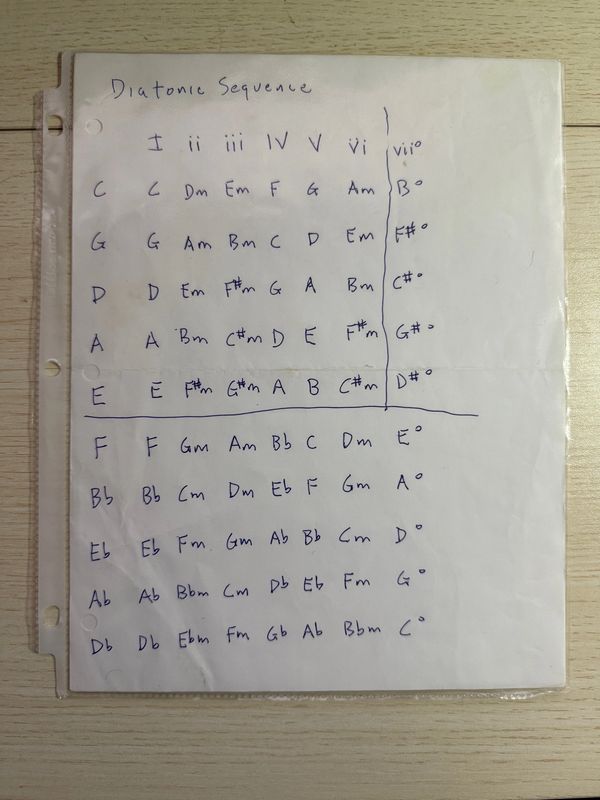
Thanks to Glenn "Houston" Pommiak for this helpful chart.
Diatonic Sequence for Piano
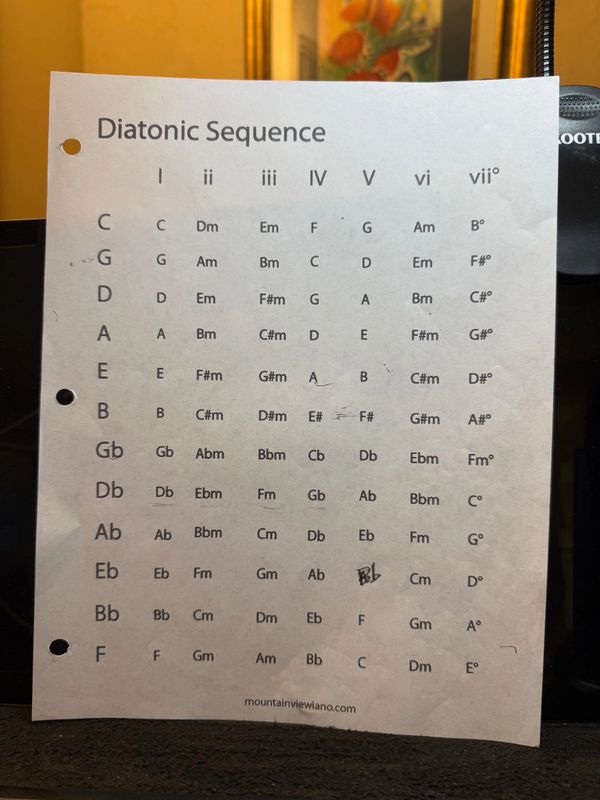
Glenn's chart expanded to all keys
Diatonic Sequence Abstracted

Diatonic Sequence Abstracted to encompass multiple notation schema
Diatonic Sequence Abstracted to Color Wheel
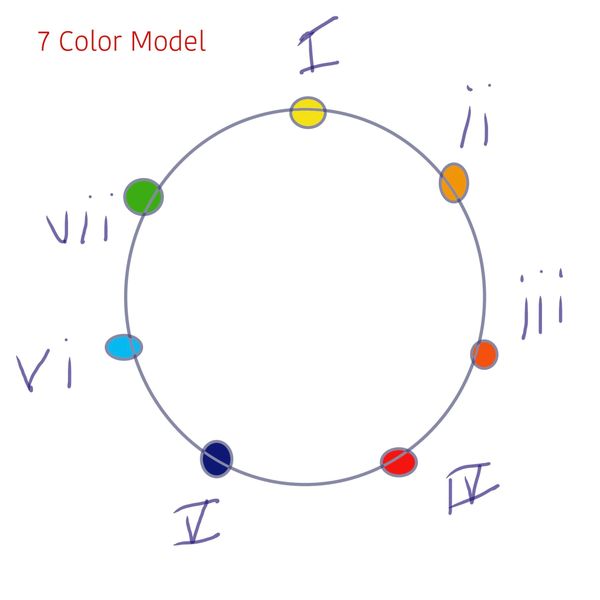
Diatonic Sequence Abstracted to encompass multiple notation schema